This sermon goes by 1 of 2 titles:
The Great Fork in the Road
The Temptation Didn't End After 40 Days
Today's Gospel lesson makes me think of two of history's finest philosophers. The first is Arnold Jackson, played by Gary Coleman on the classic television show, Diff'rent Strokes. The second is former Yankee great Yogi Berra. Two of the finest minds of the 20th century.
The story itself reminds me of one of the situations in which Arnold and Willis would inevitably find themselves. Jesus, the Willis of this story, begins to teach his disciples something brand new. It wasn't until the disciples could name him as the Messiah that Jesus could share with them the whole story. As the Messiah, Jesus had to be rejected by the religious authorities, handed over the the political powers-that-be, be killed, and on the third day rise again. That's what being the Messiah meant. It wasn't code for coup, it wasn't a secret plan hatched in the basement of Peter's Mother-in-law's house. Instead, in the middle of Caesarville, where the revolution should have started, Jesus - the anointed one of God - made it clear that to be anointed meant to die at the hands of Rome.
It is almost as if the disciples don't hear anything after, and be killed, the shock waves of that phrase were too strong; the ringing in their ears too loud, and so Peter, as the one who regularly speaks for the group, as the one who just called Jesus the Messiah steps up. I picture Peter walking over to his beloved teacher, taking his friend aside, and asking in all seriousness, "What'chu talking about Willis?"
What Jesus was talking about was mind-boggling to the disciples, and Peter had to let him know that. They were raised with an understanding that the promised Messiah would bring about the triumph of Israel, the restoration of Jerusalem, the return of YHWH to his rightful place as King of kings and Lord of lords. Suffering and death, sure, some who followed the Messiah, who fought the battles of the revolution, they might taste death, but not the Messiah, he was to sit on David's throne for ever.
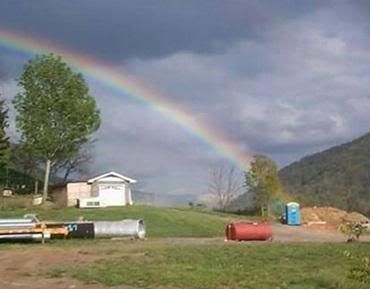
Which leads me to the Yankee catcher turned philosopher Yogi Berra. While story might remind me of Diff'rent Strokes, the plot brings to mind Yogi's oft quoted Yogi-ism, "When you come to a fork in the road, take it." We find Jesus and his disciples staring at a fork in the road, and Peter wants to take it. Looking down the one road he sees crowns, and thrones, and sweet wine. He sees positions of power for him and his friends, Roman soldiers carrying his bags. He sees the good life where "Caeserville would once again be called the region of Naphtali near the city of Dan in the foothills of Mount Hermon - -names that pointed back to the glory days of freedom under Kings David and Solomon." (CEP)
Down the other road he sees the dream of God. The land that the prophet Isaiah promised. "Righteousness will be [the Messiah's] belt and faithfulness the sash around his waist. The wolf will live with the lamb, the leopard will lie down with the goat, and the calf and the lion and the yearling together; and a little child will lead them. The cow will feed with the bear, their young will lie down together, and the lion will eat straw like the ox. The infant will play near the hole of the cobra, and the young child put his hand into the vipers' nest. They will neither harm nor destroy on all [God's] holy mountain, for the earth will be full of the knowledge of the LORD as the waters cover the sea. In that day the Root of Jesse will stand as a banner for the peoples; the nations will rally to him, and his place of rest will be glorious." (11.1-10 NIV)
Peter's sees two paths ahead; one of power and prestige and one of humility and God's glory, and he wants to take them both. When faced with a fork in the road, Peter, on behalf of the disciples, wants to take it.
And for a moment, it seems as though Jesus also wants to take them both. Mark gives us that interesting little detail. Jesus turned and looked at his disciples. As if to, just for a moment, ponder if it were possible to go down both roads. I mean, he had just fed a crowd of 4,000 men, not to mention women and children who had come to hear him speak. His popularity was growing, his message was being received, things were looking good for Jesus the revolutionary. It seems as though the temptation didn't end after the 40 days in the wilderness. The tempter was back, offering him power and prestige. And maybe, for just a moment, Jesus the man, takes a second look.
"Isn't it often the case that when we feel tempted by something, we give it a second look? You're sitting at the table in the restaurant and the waiter is holding the dessert tray. You glanced at that piece of seven layer chocolate volcano cake but decided to resist the temptation. "You sure?" the waiter says, even as he moves the tray just a wee bit in your direction. And so you give it another look." (CEP)
Unlike me and the seven lay chocolate volcano cake, Jesus' temptation only lasts a minute. Jesus, the Son of God, sees that the Tempter is at work, even in the voice of a dear friend. "Get behind me Satan!" he yells, for where temptation needles the devil is surely at play. At this fork in the road, Jesus chooses to follow the will of God; the one that leads through suffering and ultimately arrives at redemption, restoration, and wholeness. And then he invites each of us to follow him down that road. The road that requires us to lose our lives. "To lose our whole way of thinking about the world, to revalue the whole experience we know as life− trusting that our valuing of life may be the end result of the Tempter who is keeping us from knowing the whole story, from seeing the whole picture." (WP)
This Second Sunday in Lent we stand at a fork in the road. We know that we can't go both ways. We know that one path looks easy, but winds up messy. The other looks messy, but winds up glorious. Which path will you choose? Will you set your mind on divine things? Will you take up your cross? Will you lose your life? Let's walk the path of Jesus together. Amen.