March 17, 2009

interesting clarifying statement

In John 3 verse 17, Jesus says, "God did not send the Son into the world to condemn [judge] it, but in order that the world might be saved through him."

Then a few lines later he says, "This is the judgment, that the light came into the world, and people loved darkness rather than light because their deeds were evil."

Two things strike me.  First, people is a general and universal term.  While it was the religious authorities in cahoots with the Roman occupiers that brought Jesus to the cross, it was people, any and all, who love darkness who helped do the work of snuffing the light of the world.  It sounds harsh, like I'm judging, but I'm deep in the midst of people, and there are days in which I'd love the light to be just a little dimmer so that my underlying sins might not be seen.

The second thing I see this morning is that the fact that people loved darkness doesn't matter.  Jesus came not to judge the world but to save it.  It was a foregone conclusion that somebody somewhere would get angry enough at Jesus to try to extinguish his light, but it didn't matter.  Jesus was sent anyway, and sent to save the world that would rather he not have arrived.  Grace is a crazy thing.  God sent his only Son to a world that didn't really want him, knowing full well he would end up dead, and he did it anyway because he came to save it.

March 16, 2009

put the class notes away

Some Sundays I have an overwhelming urge to pull out my notes from my Seminary New Testament class and run with them, but I know that isn't an option.  As a preacher, I know that I can incorporate John's use of the cross as an almost throne upon which Jesus was raised in triumph, but I can't just site a text and say it is so - I've got to walk the people through it.

Still between John's raising of Christ like the raising of the serpent, Paul's "saved by grace through faith", and John 3.16 there is a lot of great material in my old notes.

Remind me to keep them where they belong - deep in the recesses of my harddrive.

2021 March Gathering - THIRST

Humans have a tenuous relationship with water.  It covers 71% of the earth's surface.  The human body is anywhere from 55 to 78% water.  We're told to drink at least 8 glasses of it a day.  Civilizations have historically formed around major bodies of water.  It is just a huge part of our lives, especially here in Baldwin County.  Rivers, bays, creeks, bayous, lagoons, canals, the intercoastal, the Gulf - water is a huge part of our lives.

Yet, like I said, our relationship is somewhat tenuous.  Too much or too little water, and things quickly go from balanced to wildly out of control.  Remember the lady in 2007 who died of water intoxication after the "hold your wee for a wii" radio contest?   Who can forget the pictures of a flooded New Orleans after Hurricane Katrina.  Even six inches of moving water can take your car from safely on the road to deep danger in a flash flood.  Too much of this good thing is most certainly not good.

And neither is too little.  Drought affects huge swaths of the earth in any given year.  Which leads to too little drinking water, even less crop production, and starvation.  Human beings can survive about 2 weeks without food, but only a few days without water.  Thirst is a condition known by too many.

In the fourth chapter of John's Gospel, Jesus finds himself thirsty.  Jesus had begun to gain the wrong sort of attention from the religious authorities.  So, Jesus decided to leave the Judean countryside and return to Galilee - home base for his ministry.  To get there, he had to pass through Samaria.  There were, in fact, other ways to get home, but the most direct route took you through the land of the half-bloods, the Samaritans.  For a religion based on purity of body, mind, and spirit, this trek through Samaria was a less than desirable one.  Jesus came into Shechem, a Samaritan village that bordered the field Jacob later known as Israel had given his son Joseph.  The well that Jacob dug for his family was still there, and Jesus, already worn out by the trip, sat down at the well to rest while his disciples went into the village to buy food for lunch.


A Samaritan woman came, strangely enough in the middle of the day, to draw her water.  Himself quite thirsty, Jesus said to her, "Would you give me a drink of water?"


The Samaritan woman was shocked and asked, "How come you, a Jew, are asking me, a Samaritan woman, for a drink?"  First of all, Jews in those days wouldn't be caught dead talking to Samaritans.  And secondly, men in those days wouldn't be caught dead talking to a woman without her husband present.


Undeterred, Jesus answered, "If you knew the generosity of God and who I am, you would be asking me for a drink, and I would give you fresh, living water."


The woman said, "Sir, you don't even have a bucket to draw with, and this well is deep. So how are you going to get this 'living water'? Are you a better man than our ancestor Jacob, who dug this well and drank from it, he and his sons and livestock, and passed it down to us?"


Jesus said, "Everyone who drinks this water will get thirsty again and again. Anyone who drinks the water I give will never thirst—not ever. The water I give will be an artesian spring within, gushing fountains of endless life."


The woman said, "Sir, give me this water so I won't ever get thirsty, won't ever have to come back to this well again!"


The thirst that Jesus was talking about quenching really had nothing to the water that the woman could draw from the well.  Jesus was talking about thirst for life, for meaning, for love.  The sort of thirst every human being understands.  Even the youngest child thirsts after the affection of her parents.  Later on in life we thirst for friends that understand us.  We thirst for relationships that fill us.  We thirst for all sorts of things.

Jesus promised this woman, and promises us, that he has living water to offer.  Artesian springs that will gush forth with endless life.  [Show Cat Waterfall] 

And yet, so many of us us are still thirsty.  So often, the faith handed down to us leaves us wanting.  This Church, for its part, has spent a lot of time and energy bottling up the ever flowing living water, and selling it like a commodity.  Many of us have purchased those bottles over and over and over and in the midst of tough times found what is supposed to be an endless supply instead is merely another empty water bottle.  We find ourselves standing looking at the water source, but unsure where to get out of the water commodity market and into the everflowing stream.  We are often afraid or angry or unprepared to step in.  So we go about trying to find water elsewhere, but it is never as refreshing as the spring that Jesus offered - it is never enough.

I think a lot of us are here tonight precisely because we know that we are thirsty, we understand that God offers refreshment, but the faith tradition we've known has left us parched.  Over the next few months we would like to offer the chance to move from purchasing water bottles one at a time to residing permanently in the midst of living water, to address what has left you thirsty in faith, in church, and in life.  

What if we started meeting weekly to address our collective thirst?
Would you come?
Could you come?
When?
Where?
How long?

I too am thirsty.  I long for the living water Jesus offers to overflow in my life, all the time.  I've tasted it.  I know it is good, but I know that from time to time I fail to drink it in; I fall back into the cycle of limiting God by purchasing water bottles.  I want to help you find living water, just as I want you to help me find it.

I want to move into the pool of living water, and I hope you do too.  In the next few minutes of silence, I invite you to reflect on the water sources in your life.  If you feel compelled to move into this terrible representation of the spring of living water, you can take a ridiculous fireman or policeman (sorry ladies, there is no gender equality in the world of dollar tree plastic toy people) and place it in there.  If you feel weird doing that, which you no doubt will, you don't have to.  Just ponder for a few minutes -

What am I thirsty for?
How can this community help channel the living water in your direction?

As we wrap up and move back into conversation and break bread together I will offer a prayer for refreshment, during which you'll have time to offer prayers for those who, for whatever reason, need the spring of living water.

--SILENCE--


O God, you have created all things by the power of your Word, and you renew the earth by your Spirit: Give now the water of life to those who thirst for you, that they may bring forth abundant fruit in your glorious kingdom; through Jesus Christ our Lord. Amen.

Readings for Lent 4, Year B

March 12, 2009

idol worship

Bishop Mark Dyer says that every 500 hundred years the Church holds a giant rummage sale.

Phyllis Tickle (among others) says the classified ad space has been purchased, and the sale is ongoing.

The lessons for this Sunday say that it is and will be ok.

The OT lesson, the 10 Commandments, reminded me this morning of how often the Church makes idols of things; the Bible (KJV or otherwise), the Book of Common Prayer, collars, vesteture, narthex(es), altar rails, etc.  Because we associate this stuff with the worship of the LORD, it often finds its way into our "sacrosanct" category - the stuff we can't live without.

At some point, however, it becomes hard to discern what we are actually worshiping.  Is it stained glass windows, altar rails, and organ music or the LORD?  If you try to eliminate any of the first three, you'll quickly find that the last is just an innocent bystander.

Jesus turned over the tables in the Temple because the system had become an idol - they went through the motions to get their card punched, and plenty of people were willing to make some money helping others assuage their guilt.

What would Jesus thrash with a whip of cords in our day and time?  What has become an idol?  Who are our moneychangers?

March 10, 2009

the engine remains strong

Here's what I thought was key to our discussion of John 2.13-22 thig morning.

The engine remains strong
The body is either too big and bulky or rusted and falling apart
Will you allow God to rebuild a new thing around that finely tuned engine?

March 9, 2009

history is important

As an arrogant emergent, I am often accused of throwing out the baby with the bath water.  As a relative conservative, this makes me laugh.  As a theologian it makes me cry.

History is important to the faith.

The story of salvation is one of history - a story told and retold and re-retold over and over again.

Take, for example, the 10 Commandments.  The core of the covenant between God and the people of Isreal begins with history - I am the LORD your God, who brought you out of the land of Egypt, out of the house of slavery.  REMEMBER!?!?!?

The story of the past cannot be thrown out.  It is too rich.  It is too important.  It carries too much weight.  God created out of nothing.  God saved for no real reason.  God forgives.  God wants to restore.  We need to hear these things over and over again.  We need to be reminded of the story, the history, of the faith.  As NT Wright says, without a knowledge of the history, there is nothing to draw on to improv.

History is important

Readings for Lent 3B

Sermon for Lent 2b

This sermon goes by 1 of 2 titles:
The Great Fork in the Road
The Temptation Didn't End After 40 Days

Today's Gospel lesson makes me think of two of history's finest philosophers.  The first is Arnold Jackson, played by Gary Coleman on the classic television show, Diff'rent Strokes.  The second is former Yankee great Yogi Berra.  Two of the finest minds of the 20th century.
    The story itself reminds me of one of the situations in which Arnold and Willis would inevitably find themselves.  Jesus, the Willis of this story, begins to teach his disciples something brand new.  It wasn't until the disciples could name him as the Messiah that Jesus could share with them the whole story.  As the Messiah, Jesus had to be rejected by the religious authorities, handed over the the political powers-that-be, be killed, and on the third day rise again.  That's what being the Messiah meant.  It wasn't code for coup, it wasn't a secret plan hatched in the basement of Peter's Mother-in-law's house.  Instead, in the middle of Caesarville, where the revolution should have started, Jesus - the anointed one of God - made it clear that to be anointed meant to die at the hands of Rome.
    It is almost as if the disciples don't hear anything after, and be killed, the shock waves of that phrase were too strong; the ringing in their ears too loud, and so Peter, as the one who regularly speaks for the group, as the one who just called Jesus the Messiah steps up.  I picture Peter walking over to his beloved teacher, taking his friend aside, and asking in all seriousness, "What'chu talking about Willis?"
    What Jesus was talking about was mind-boggling to the disciples, and Peter had to let him know that.  They were raised with an understanding that the promised Messiah would bring about the triumph of Israel, the restoration of Jerusalem, the return of YHWH to his rightful place as King of kings and Lord of lords.  Suffering and death, sure, some who followed the Messiah, who fought the battles of the revolution, they might taste death, but not the Messiah, he was to sit on David's throne for ever.
    Which leads me to the Yankee catcher turned philosopher Yogi Berra.  While story might remind me of Diff'rent Strokes, the plot brings to mind Yogi's oft quoted Yogi-ism, "When you come to a fork in the road, take it."  We find Jesus and his disciples staring at a fork in the road, and Peter wants to take it.  Looking down the one road he sees crowns, and thrones, and sweet wine.  He sees positions of power for him and his friends, Roman soldiers carrying his bags.  He sees the good life where "Caeserville would once again be called the region of Naphtali near the city of Dan in the foothills of Mount Hermon - -names that pointed back to the glory days of freedom under Kings David and Solomon." (CEP)
    Down the other road he sees the dream of God.  The land that the prophet Isaiah promised.  "Righteousness will be [the Messiah's] belt and faithfulness the sash around his waist.  The wolf will live with the lamb, the leopard will lie down with the goat, and the calf and the lion and the yearling together; and a little child will lead them.  The cow will feed with the bear, their young will lie down together, and the lion will eat straw like the ox.  The infant will play near the hole of the cobra, and the young child put his hand into the vipers' nest.  They will neither harm nor destroy on all [God's] holy mountain, for the earth will be full of the knowledge of the LORD as the waters cover the sea.  In that day the Root of Jesse will stand as a banner for the peoples; the nations will rally to him, and his place of rest will be glorious." (11.1-10 NIV)
    Peter's sees two paths ahead; one of power and prestige and one of humility and God's glory, and he wants to take them both.  When faced with a fork in the road, Peter, on behalf of the disciples, wants to take it.
    And for a moment, it seems as though Jesus also wants to take them both.  Mark gives us that interesting little detail.  Jesus turned and looked at his disciples.  As if to, just for a moment, ponder if it were possible to go down both roads. I mean, he had just fed a crowd of 4,000 men, not to mention women and children who had come to hear him speak.  His popularity was growing, his message was being received, things were looking good for Jesus the revolutionary.  It seems as though the temptation didn't end after the 40 days in the wilderness.  The tempter was back, offering him power and prestige.  And maybe, for just a moment, Jesus the man, takes a second look.
    "Isn't it often the case that when we feel tempted by something, we give it a second look? You're sitting at the table in the restaurant and the waiter is holding the dessert tray. You glanced at that piece of seven layer chocolate volcano cake but decided to resist the temptation. "You sure?" the waiter says, even as he moves the tray just a wee bit in your direction. And so you give it another look." (CEP)
    Unlike me and the seven lay chocolate volcano cake, Jesus' temptation  only lasts a minute.  Jesus, the Son of God, sees that the Tempter is at work, even in the voice of a dear friend.  "Get behind me Satan!" he yells, for where temptation needles the devil is surely at play.  At this fork in the road, Jesus chooses to follow the will of God; the one that leads through suffering and ultimately arrives at redemption, restoration, and wholeness.  And then he invites each of us to follow him down that road.  The road that requires us to lose our lives.  "To lose our whole way of thinking about the world, to revalue the whole experience we know as life− trusting that our valuing of life may be the end result of the Tempter who is keeping us from knowing the whole story, from seeing the whole picture." (WP)
    This Second Sunday in Lent we stand at a fork in the road.  We know that we can't go both ways.  We know that one path looks easy, but winds up messy.  The other looks messy, but winds up glorious.  Which path will you choose?  Will you set your mind on divine things?  Will you take up your cross?  Will you lose your life?  Let's walk the path of Jesus together.  Amen.

March 5, 2009

Lent 1B Wednesday Homily

Have you ever tried to imagine what life was like before written language, before history was solidified, before science took on the task of explaining natural phenomenon?  I'm sure you have.  Remember as a child trying to come up with explanations for things?  When I was little we thought that thunder was the sound of God bowling, and I won't tell you what we thought rain was, but suffice it to say I still won't drink raindrops or eat snow.

What are some of the naturally occurring things that you found just amazing as a child?

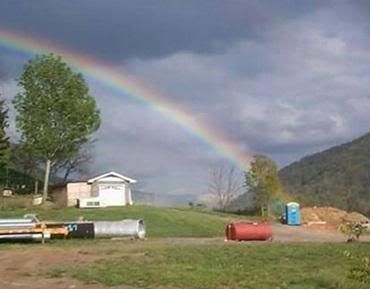
For the ancient world, one thing that sat near the top of most lists was the rainbow.  Such a beautiful sight; its colors arching across the sky.  Across the ancient world the rainbow took on all sorts of meanings.


We even have some modern day thoughts about the rainbow.  
EndOfRainbow.jpg end Of the Rainbow image by omniviking

But for the precursors of our faith, the rainbow was, and is, something very unique.  It is a reminder FOR GOD of a promise he has made.  Let me repeat that - a reminder FOR GOD.  It isn't set in the clouds to remind us to follow the God who makes all things possible, it is a reminder FOR GOD that he promised to never again destroy the earth with a flood.

Can you imagine hearing that for the first time?  Imagine for a moment being Noah and his sons.  You have just recently stepped on dry ground for the first time in more than a year when God decides to make a pact, ""As for me, I am establishing my covenant with you and your descendants after you, and with every living creature that is with you, the birds, the domestic animals, and every animal of the earth with you, as many as came out of the ark. I establish my covenant with you, that never again shall all flesh be cut off by the waters of a flood, and never again shall there be a flood to destroy the earth."

Can you hear those two crickets chirping and Noah and his sons tried desperately to understand the words they are hearing?

So God continues, "This is the sign of the covenant that I make between me and you and every living creature that is with you, for all future generations: I have set my bow in the clouds, and it shall be a sign of the covenant between me and the earth. When I bring clouds over the earth and the bow is seen in the clouds, I will remember my covenant that is between me and you and every living creature of all flesh; and the waters shall never again become a flood to destroy all flesh. When the bow is in the clouds, I will see it and remember the everlasting covenant between God and every living creature of all flesh that is on the earth."

God is hanging up his bow, the battle between him and his creation is over, but just in case he gets angry again, he's keeping it there to remind him.  

Can you imagine?

To our 21st century ears this kind of covenant between God and humankind makes no sense.  Our God, we think, is one of grace and peace and love.  That's somebody else's God in Genesis chapters six through nine.

But what if we began to look at the rainbow the way our ancestors did?  Instead of seeing it as light refracting through millions of water droplets, instead of getting upset with a God who got angry, what if we looked up and saw the promise of God that he would forgive forever?  What if we saw in the rainbow the grace of God that he promised all those many years ago?

It would lead us, I think, to rejoicing.  It would recall for us that God fulfilled his promise and that the kingdom of God has come so that even in our various weaknesses, God forgives.  What if we saw forgiveness in rainbows?  What if?

Amen.

Name Change

As a guy who fancies himself postmodern, I get that names are important.  Words are important.   My faith that a rainbow is God's reminder to Himself of a covenant made for eternity is another man's myth.  I get it.   What we call things is important.

There are three important names in the lessons for Sunday (two explicit, one contextual).

Abram becomes Abraham - the exalted father of many nations
Sarai become Sarah - the princess mother of many kings

Napthali became Caeserea Philippi - Caeserville in the land promised to God's chosen people (the place where Peter calls Jesus "Messiah" and then tries to begin a revolution)

It is a little known (and less often used) historical fact that names can be changed at baptism and at ordination (there may be other times that I am not aware of).  Abraham and Sarah have their names changed by God because their relationship is changing.  So too can we have our names changed when the rules by which we choose to play change.

Stalingrad is once again St. Petersberg - the rules changed.  For Peter, Caeserea needed to return to Napthali, but Jesus knows that isn't going to happen because this rule change is much larger than revolution and political power.  This new set of rules is the installation of the kingdom of God.  Names may change, but it is the hearts that change that matter.

Abram wouldn't become Abraham without faith.  Sarai wouldn't become Sarah without faith.  And we don't become Christians without faith.

Name changes are important, but more important is why the change happened.


March 4, 2009

motivations

The old saying goes, "the road to hell is paved with good intentions."  Jesus himself seems to set us upon that road in the gospel for Sunday.

"If any want to become my followers, let them deny themselves and take up their cross and follow me. For those who want to save their life will lose it, and those who lose their life for my sake, and for the sake of the gospel, will save it."

It sounds like we should give up our lives becuase in doing so we can save it, but I'm not sure that's the motivaiton Jesus had in mind.  Do I do a good work just to do it, or do I do it to get credit?  Seems to me I should just do good because it is good, regardless of the reward.  Setting up a reward makes the motivations mixed, makes the intentions somewhat impure.

Do I deny myself and follow Jesus beacuse it is the dream of God, or, do I deny myself and follow Jesus to get my everlasting life card-punched?  Geez, tough one.  Getting my card-punched would be nice - it'd be great to be sure that I had done what is required of me, but maybe what is required is doing it just because it is God's dream.

March 3, 2009

choices

So much of the kingdom life comes down to choices.  So much so, that if pressed to answer when I was "saved" I'd say that I was "saved" 2000 years ago in the incarnation and resurrection, but most recenlty I was "saved" this morning when I chose to live for the kingdom instead of myself.  This Sunday's lessons reminded me of the importance of choices.

In the collect we ask God to bring us to the choice of embracing his way.

Abraham is asked to choose between the old way of Abram and the new way of God.

The Psalmist declares, "my soul shall live for him..."

Paul gives Abraham credit for choosing to be the father of many nations; which is, in Paul's eyes what made Abraham righteous.

Jesus calls his disciples throughout the generations to choose to walk behind him as followers not pushing him like a shopping cart down the candy aisle.

The choices we make are important.  Having been "saved" once-for-all by the life, death, and resurrection of God; I am left to choose that path of righteousness or play my luck on any other path.  Today, and thanks be to God for it, I chose his path.  Here's "hoping against hope" I make the same choice tomorrow.

March 2, 2009

cry out

In his new book, Jesus Wants to Save Christians, Rob Bell (with Don Golden) breaks down the story of salvation history into a series of four repeating events; oppression, crying out, redemption, triumphalism (my paraphrase). 

I am struck by the lectionary for Sunday and just how that four-fold cycle plays out over and over and over again.

Ps 22.23 - "For he does not despise nor abhor the poor in their poverty; neither does he hide his face from them; * but when they cry to him he hears them.

In the Collect, we cry out, "O God,... be gracious..."

Our poverty is not that of material things, despite what talking heads on CNN tell us.  Our poverty is that of Peter, we can't see the plan.  Our ways are not God's ways.  Our poverty is that we have gone astray, focused on our own devices and desires and now, in the midst of crisis, we cry out, "O God..."

Be assured, however, that God hears our cry.  Just as he heard the cry of Abram and made him the father of many nations, so too God hears our cry.  Our restoration won't necessarily look like we want it to.  It might mean 40 years in the desert, or 40 days in the wilderness, or 24 hours of a sham trial and death on a cross, but God will hear our cry.  So go ahead, cry out!

Readings for Lent 2B